
Introduction
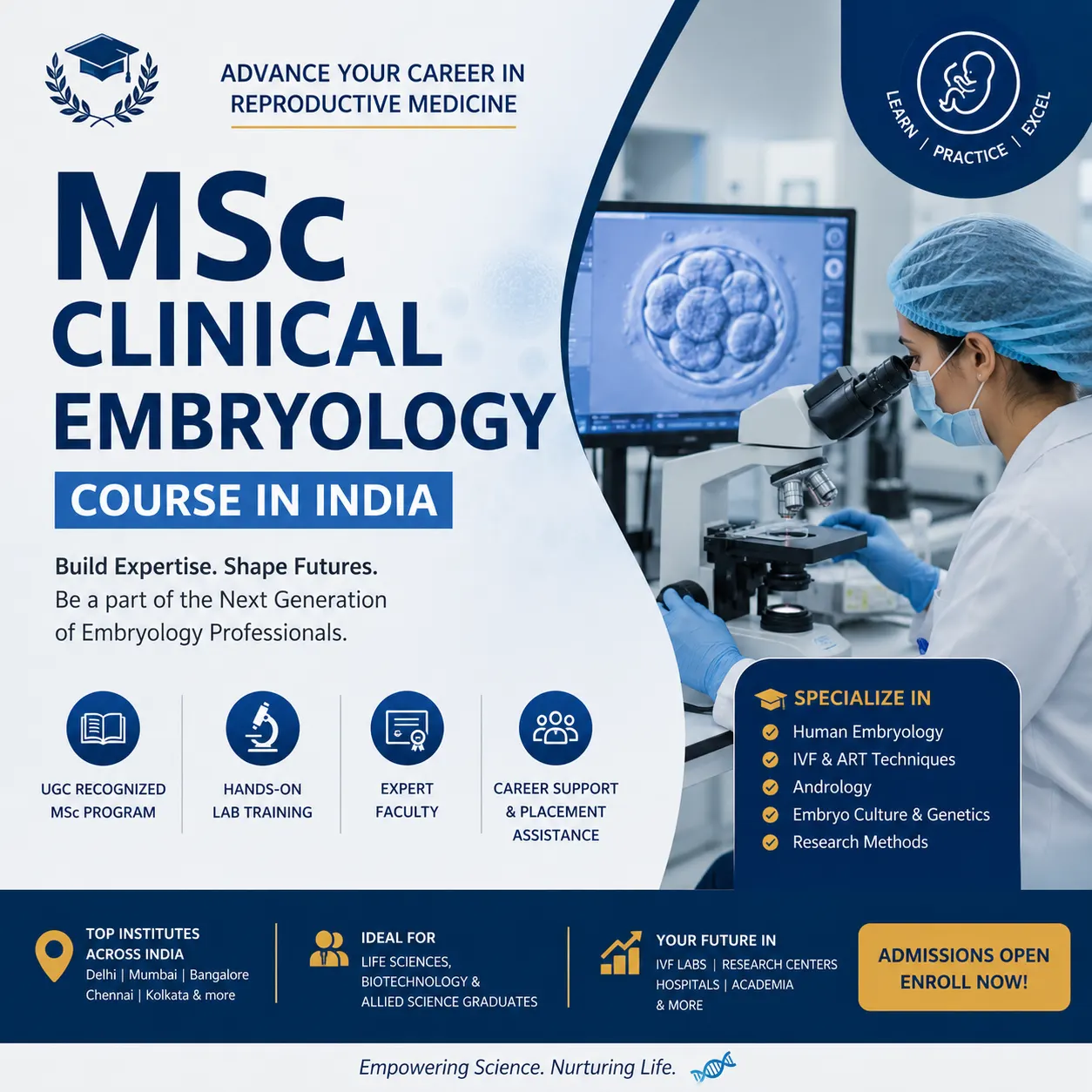
MSc Clinical Embryology is a specialised postgraduate program designed for students who want to build a professional career in IVF, fertility science, assisted reproductive technology, and reproductive laboratory practice. The course focuses on the scientific study of human reproduction, embryo development, fertilisation techniques, laboratory handling, cryopreservation, and clinical embryology procedures used in modern fertility centres.
In India, the demand for trained clinical embryologists is increasing because infertility treatment, IVF centres, fertility clinics, and ART laboratories are expanding rapidly. Students from life sciences, biotechnology, zoology, microbiology, medical laboratory technology, and related backgrounds are now exploring MSc Clinical Embryology as a career-focused program with strong practical value.
Embryopath offers academic guidance and practical learning support for students interested in clinical embryology education in academic collaboration with GD Goenka University. The focus is to help students understand not only the theory of embryology but also the real clinical environment of IVF laboratories.
Quick Answer: What is MSc Clinical Embryology?
MSc Clinical Embryology is a postgraduate degree program that trains students in human reproductive biology, IVF laboratory techniques, embryo culture, gamete handling, fertilisation methods, cryopreservation, and assisted reproductive technology. The course prepares students for careers as clinical embryologists, IVF lab professionals, fertility lab coordinators, research associates, and reproductive science professionals.
Why MSc Clinical Embryology is Important
Clinical embryology plays a major role in assisted reproduction. In an IVF cycle, the embryologist works behind the scenes in the laboratory and handles some of the most sensitive steps, including sperm preparation, oocyte handling, fertilisation observation, embryo grading, embryo culture, vitrification, and embryo transfer preparation.
The quality of embryology training directly affects laboratory performance, patient confidence, and fertility treatment outcomes. This is why fertility centres prefer candidates who have strong academic knowledge, practical laboratory exposure, attention to detail, and ethical understanding of ART procedures.
Key Benefits of Studying MSc Clinical Embryology
- Specialised career path in IVF and fertility sciences
- Strong demand in India and abroad
- Practical laboratory-based learning
- Career opportunities in IVF clinics, fertility hospitals, ART centres, and research labs
- Opportunity to work with advanced reproductive technologies
- Professional growth as a clinical embryologist or IVF lab specialist
- Scope for higher research, training, and international career development
MSc Clinical Embryology Course Overview
| Course Name | MSc Clinical Embryology |
|---|---|
| Course Level | Postgraduate |
| Field | Clinical Embryology, IVF, ART, Fertility Science |
| Ideal For | Life Science, Biotechnology, Zoology, Microbiology, MLT and Allied Health graduates |
| Learning Mode | Theory + Practical Laboratory Training |
| Career Path | Clinical Embryologist, IVF Lab Executive, ART Lab Professional, Research Associate |
Eligibility for MSc Clinical Embryology
The eligibility criteria may vary depending on university guidelines, but generally, students with a background in life sciences, biological sciences, medical laboratory technology, biotechnology, microbiology, zoology, biochemistry, reproductive biology, or related disciplines can apply for MSc Clinical Embryology.
Common Eligibility Criteria
- Bachelor’s degree in a relevant science or allied health discipline
- Basic understanding of biology, human physiology, or laboratory science
- Interest in reproductive medicine and clinical laboratory work
- Ability to work carefully in a sensitive medical laboratory environment
- Good observation, documentation, and communication skills
Admission Process
The admission process for MSc Clinical Embryology usually includes application submission, eligibility verification, counselling, document review, fee confirmation, and final admission. Students should keep their academic documents, identity proof, photographs, and previous qualification certificates ready before applying.
Step-by-Step Admission Process
- Submit the enquiry or application form.
- Speak with the admission counselling team.
- Check eligibility based on academic background.
- Submit required documents for verification.
- Understand course structure, training support, scholarship options, and fee details.
- Complete admission formalities.
- Start academic and practical training as per schedule.
Course Duration
MSc Clinical Embryology is generally structured as a postgraduate program with academic learning, laboratory exposure, practical sessions, case-based understanding, and professional development. The exact duration and semester structure may depend on university regulations and institutional planning.
Curriculum of MSc Clinical Embryology
The curriculum is designed to build a strong foundation in reproductive biology and gradually move students towards advanced IVF laboratory procedures. A good curriculum should balance theory, practical training, laboratory protocols, ethics, safety, and clinical relevance.
Core Subjects Usually Covered
| Subject Area | Learning Focus |
|---|---|
| Human Reproductive Biology | Male and female reproductive systems, gametogenesis, fertilisation |
| Clinical Embryology | Embryo development, embryo grading, culture systems |
| Assisted Reproductive Technology | IVF, ICSI, embryo transfer support, ART lab workflow |
| Andrology | Semen analysis, sperm preparation, male fertility assessment |
| Cryobiology | Freezing, vitrification, thawing, cryostorage principles |
| Laboratory Management | Quality control, documentation, safety, lab ethics |
Practical Training in MSc Clinical Embryology
Practical training is one of the most important parts of MSc Clinical Embryology. Students must understand how IVF laboratories function, how samples are handled, how equipment is maintained, and how embryology procedures are performed with accuracy and responsibility.
Practical Training May Include
- Microscope handling and observation techniques
- Basic embryology laboratory orientation
- Culture media understanding
- Semen analysis and sperm preparation basics
- Oocyte and embryo handling concepts
- Embryo grading principles
- Cryopreservation and vitrification concepts
- Lab safety, hygiene, documentation, and quality control
Introduction
MSc Clinical Embryology is a specialised postgraduate program designed for students who want to build a professional career in IVF, fertility science, assisted reproductive technology, and reproductive laboratory practice. The course focuses on the scientific study of human reproduction, embryo development, fertilisation techniques, laboratory handling, cryopreservation, and clinical embryology procedures used in modern fertility centres.
In India, the demand for trained clinical embryologists is increasing because infertility treatment, IVF centres, fertility clinics, and ART laboratories are expanding rapidly. Students from life sciences, biotechnology, zoology, microbiology, medical laboratory technology, and related backgrounds are now exploring MSc Clinical Embryology as a career-focused program with strong practical value.
Embryopath offers academic guidance and practical learning support for students interested in clinical embryology education in academic collaboration with GD Goenka University. The focus is to help students understand not only the theory of embryology but also the real clinical environment of IVF laboratories.
Quick Answer: What is MSc Clinical Embryology?
MSc Clinical Embryology is a postgraduate degree program that trains students in human reproductive biology, IVF laboratory techniques, embryo culture, gamete handling, fertilisation methods, cryopreservation, and assisted reproductive technology. The course prepares students for careers as clinical embryologists, IVF lab professionals, fertility lab coordinators, research associates, and reproductive science professionals.
Why MSc Clinical Embryology is Important
Clinical embryology plays a major role in assisted reproduction. In an IVF cycle, the embryologist works behind the scenes in the laboratory and handles some of the most sensitive steps, including sperm preparation, oocyte handling, fertilisation observation, embryo grading, embryo culture, vitrification, and embryo transfer preparation.
The quality of embryology training directly affects laboratory performance, patient confidence, and fertility treatment outcomes. This is why fertility centres prefer candidates who have strong academic knowledge, practical laboratory exposure, attention to detail, and ethical understanding of ART procedures.
Key Benefits of Studying MSc Clinical Embryology
- Specialised career path in IVF and fertility sciences
- Strong demand in India and abroad
- Practical laboratory-based learning
- Career opportunities in IVF clinics, fertility hospitals, ART centres, and research labs
- Opportunity to work with advanced reproductive technologies
- Professional growth as a clinical embryologist or IVF lab specialist
- Scope for higher research, training, and international career development
MSc Clinical Embryology Course Overview
| Course Name | MSc Clinical Embryology |
|---|---|
| Course Level | Postgraduate |
| Field | Clinical Embryology, IVF, ART, Fertility Science |
| Ideal For | Life Science, Biotechnology, Zoology, Microbiology, MLT and Allied Health graduates |
| Learning Mode | Theory + Practical Laboratory Training |
| Career Path | Clinical Embryologist, IVF Lab Executive, ART Lab Professional, Research Associate |
Eligibility for MSc Clinical Embryology
The eligibility criteria may vary depending on university guidelines, but generally, students with a background in life sciences, biological sciences, medical laboratory technology, biotechnology, microbiology, zoology, biochemistry, reproductive biology, or related disciplines can apply for MSc Clinical Embryology.
Common Eligibility Criteria
- Bachelor’s degree in a relevant science or allied health discipline
- Basic understanding of biology, human physiology, or laboratory science
- Interest in reproductive medicine and clinical laboratory work
- Ability to work carefully in a sensitive medical laboratory environment
- Good observation, documentation, and communication skills
Admission Process
The admission process for MSc Clinical Embryology usually includes application submission, eligibility verification, counselling, document review, fee confirmation, and final admission. Students should keep their academic documents, identity proof, photographs, and previous qualification certificates ready before applying.
Step-by-Step Admission Process
- Submit the enquiry or application form.
- Speak with the admission counselling team.
- Check eligibility based on academic background.
- Submit required documents for verification.
- Understand course structure, training support, scholarship options, and fee details.
- Complete admission formalities.
- Start academic and practical training as per schedule.
Course Duration
MSc Clinical Embryology is generally structured as a postgraduate program with academic learning, laboratory exposure, practical sessions, case-based understanding, and professional development. The exact duration and semester structure may depend on university regulations and institutional planning.
Curriculum of MSc Clinical Embryology
The curriculum is designed to build a strong foundation in reproductive biology and gradually move students towards advanced IVF laboratory procedures. A good curriculum should balance theory, practical training, laboratory protocols, ethics, safety, and clinical relevance.
Core Subjects Usually Covered
| Subject Area | Learning Focus |
|---|---|
| Human Reproductive Biology | Male and female reproductive systems, gametogenesis, fertilisation |
| Clinical Embryology | Embryo development, embryo grading, culture systems |
| Assisted Reproductive Technology | IVF, ICSI, embryo transfer support, ART lab workflow |
| Andrology | Semen analysis, sperm preparation, male fertility assessment |
| Cryobiology | Freezing, vitrification, thawing, cryostorage principles |
| Laboratory Management | Quality control, documentation, safety, lab ethics |
Practical Training in MSc Clinical Embryology
Practical training is one of the most important parts of MSc Clinical Embryology. Students must understand how IVF laboratories function, how samples are handled, how equipment is maintained, and how embryology procedures are performed with accuracy and responsibility.
Practical Training May Include
- Microscope handling and observation techniques
- Basic embryology laboratory orientation
- Culture media understanding
- Semen analysis and sperm preparation basics
- Oocyte and embryo handling concepts
- Embryo grading principles
- Cryopreservation and vitrification concepts
- Lab safety, hygiene, documentation, and quality control
Frequently Asked Questions About MSc Clinical Embryology
1. What is MSc Clinical Embryology?
MSc Clinical Embryology is a postgraduate program focused on human reproduction, fertility science, IVF laboratory procedures, embryo development, and assisted reproductive technology. The course helps students understand how fertilisation, embryo culture, gamete handling, cryopreservation, and laboratory quality control are performed in modern fertility centres. It is suitable for students who want to build a career as clinical embryologists, IVF lab professionals, ART laboratory associates, or reproductive science specialists. At Embryopath, the program is designed to provide academic learning along with practical exposure so students can understand the real requirements of embryology laboratories. The academic collaboration with GD Goenka University adds structured learning value and helps students follow a professional education pathway in clinical embryology.
2. Who can apply for MSc Clinical Embryology?
Students with a background in life sciences, biotechnology, zoology, microbiology, biochemistry, medical laboratory technology, reproductive biology, or allied health sciences can generally apply for MSc Clinical Embryology. Eligibility may vary depending on university and admission guidelines, so students should confirm the current criteria before applying. The course is ideal for candidates who have a strong interest in human reproduction, IVF technology, laboratory science, fertility treatment, and clinical research. Since embryology requires precision, patience, ethics, and scientific understanding, students should be comfortable working in a sensitive laboratory environment. Embryopath guides eligible students through the admission process and helps them understand the course structure, academic requirements, practical training approach, and career opportunities in clinical embryology.
3. Is MSc Clinical Embryology a good career option in India?
Yes, MSc Clinical Embryology is a strong career option in India because the fertility and IVF sector is growing rapidly. More couples are seeking assisted reproductive treatments, and IVF centres are expanding across metro cities as well as tier-2 and tier-3 locations. This growth has increased the demand for trained embryologists and ART laboratory professionals. Students who complete structured education with practical training can explore career opportunities in fertility clinics, IVF hospitals, ART laboratories, research centres, and healthcare institutions. The career can be rewarding for students who enjoy science, laboratory work, reproductive medicine, and patient-focused healthcare. Embryopath focuses on career-oriented learning so students can develop academic confidence and practical understanding for the IVF industry.
4. What is the duration of MSc Clinical Embryology?
The duration of MSc Clinical Embryology is generally two years, divided into semesters as per university guidelines. During the course, students study reproductive biology, embryology, IVF techniques, andrology, cryobiology, laboratory management, research methods, and clinical applications of assisted reproductive technology. The program also includes practical training and laboratory exposure, which are essential for building real professional skills. Students should always verify the exact course duration, semester structure, internship requirements, and academic calendar during admission because these may depend on institutional and university regulations. At Embryopath, students receive guidance regarding course structure, academic planning, practical learning, and career preparation through its academic collaboration with GD Goenka University.
5. What are the main subjects in MSc Clinical Embryology?
The main subjects in MSc Clinical Embryology usually include human reproductive biology, gametogenesis, fertilisation, embryo development, IVF laboratory techniques, clinical embryology, andrology, cryopreservation, ART procedures, embryo culture, laboratory safety, quality control, and reproductive ethics. Students may also study research methodology, genetics, infertility assessment, semen analysis, sperm preparation, embryo grading, vitrification concepts, and laboratory documentation. A good curriculum balances theory with practical understanding so students can connect academic concepts with real IVF laboratory requirements. Embryopath focuses on helping students understand both the scientific foundation and professional application of clinical embryology, making the learning process more useful for future careers in fertility centres and reproductive medicine.
6. What practical training is included in MSc Clinical Embryology?
Practical training in MSc Clinical Embryology may include microscope handling, semen analysis basics, sperm preparation concepts, embryo observation, culture media understanding, laboratory safety, documentation, cryopreservation concepts, and IVF lab workflow. Students also learn about quality control, contamination prevention, equipment handling, incubator management, and ethical laboratory practices. Practical exposure is important because embryology is a skill-based field where accuracy, timing, hygiene, observation, and responsibility matter. The goal is to help students become familiar with the controlled environment of an ART laboratory. Embryopath gives importance to practical learning so students can understand how theoretical knowledge is applied in fertility laboratories and clinical embryology practice.
7. What is the admission process for MSc Clinical Embryology?
The admission process for MSc Clinical Embryology usually begins with submitting an enquiry or application form. After that, the admission team reviews the student’s academic background and confirms eligibility. Students may need to submit educational certificates, identity proof, photographs, and other required documents. Counselling may also be provided to explain the course structure, fees, scholarship options, practical training, career scope, and placement support. Once eligibility and documents are verified, students can complete the admission formalities. Embryopath supports students throughout this process by offering guidance on eligibility, academic collaboration with GD Goenka University, course benefits, and career opportunities in the field of clinical embryology.
8. What is the career scope after MSc Clinical Embryology?
After completing MSc Clinical Embryology, students can explore career opportunities in IVF centres, fertility hospitals, ART laboratories, reproductive medicine clinics, research institutions, diagnostic laboratories, and academic organisations. Common job roles include junior embryologist, clinical embryologist, IVF laboratory executive, ART lab coordinator, research associate, andrology lab assistant, fertility lab professional, and academic trainer. With experience, professionals can move into senior embryologist roles, laboratory management, research, teaching, and international opportunities. The career scope depends on practical skills, academic performance, laboratory exposure, communication ability, and continuous learning. Embryopath helps students build a strong academic and practical foundation for entering this growing healthcare field.
9. What salary can I expect after MSc Clinical Embryology?
Salary after MSc Clinical Embryology depends on the candidate’s skills, practical exposure, location, employer, job role, and experience level. Freshers usually begin with junior embryology or IVF laboratory roles, while experienced professionals can progress into independent embryologist, senior embryologist, lab supervisor, or ART laboratory management positions. Salaries are generally higher for candidates who develop strong practical competency, ethical laboratory handling, documentation skills, and advanced IVF technique understanding. International opportunities may offer better earning potential, but they often require additional certifications, experience, licensing, or country-specific eligibility. Students should focus on building strong laboratory skills and professional discipline during the course to improve long-term career growth.
10. Why choose Embryopath for MSc Clinical Embryology?
Embryopath is a suitable choice for students who want career-focused education in clinical embryology with strong academic guidance and practical learning support. The institute focuses on helping students understand reproductive biology, IVF laboratory workflow, clinical embryology techniques, laboratory ethics, documentation, and career preparation. Its academic collaboration with GD Goenka University adds structured educational value and supports a professional learning environment. Students can also benefit from counselling, scholarship information, placement guidance, and practical exposure designed around industry expectations. Embryopath aims to prepare students for real career opportunities in IVF centres, fertility clinics, ART laboratories, research organisations, and reproductive healthcare institutions in India and abroad.